9
What Is a Schumer Box and How Do You Read It?

What Is a Schumer Box and How Do You Read It?
A Schumer box is a legally required cheat sheet for credit cards that breaks down two main aspects of any card: interest rates and fees. Here's how to read it and where to find it.
Many or all of the products on this page are from partners who compensate us when you click to or take an action on their website, but this does not influence our evaluations or ratings. Our opinions are our own.
Updated · 3 min read

Written by
Managing Editor

Edited by
Director of Content
What Is a Schumer Box and How Do You Read It?
A Schumer box is a legally required cheat sheet for credit cards that breaks down two main aspects of any card: interest rates and fees. Here's how to read it and where to find it.
Many or all of the products on this page are from partners who compensate us when you click to or take an action on their website, but this does not influence our evaluations or ratings. Our opinions are our own.
Updated · 3 min read
Written by
Managing Editor
Edited by
Director of Content
What is a Schumer box? It's a cheat sheet about a credit card — an at-a-glance reference for fees, interest rates and other key points that must be shown to card applicants, by law.
But when it comes to these kinds of credit card terms and conditions, you sometimes need a cheat sheet on reading cheat sheets. Here's our guide to reading and understanding the Schumer box.
All about the Schumer box
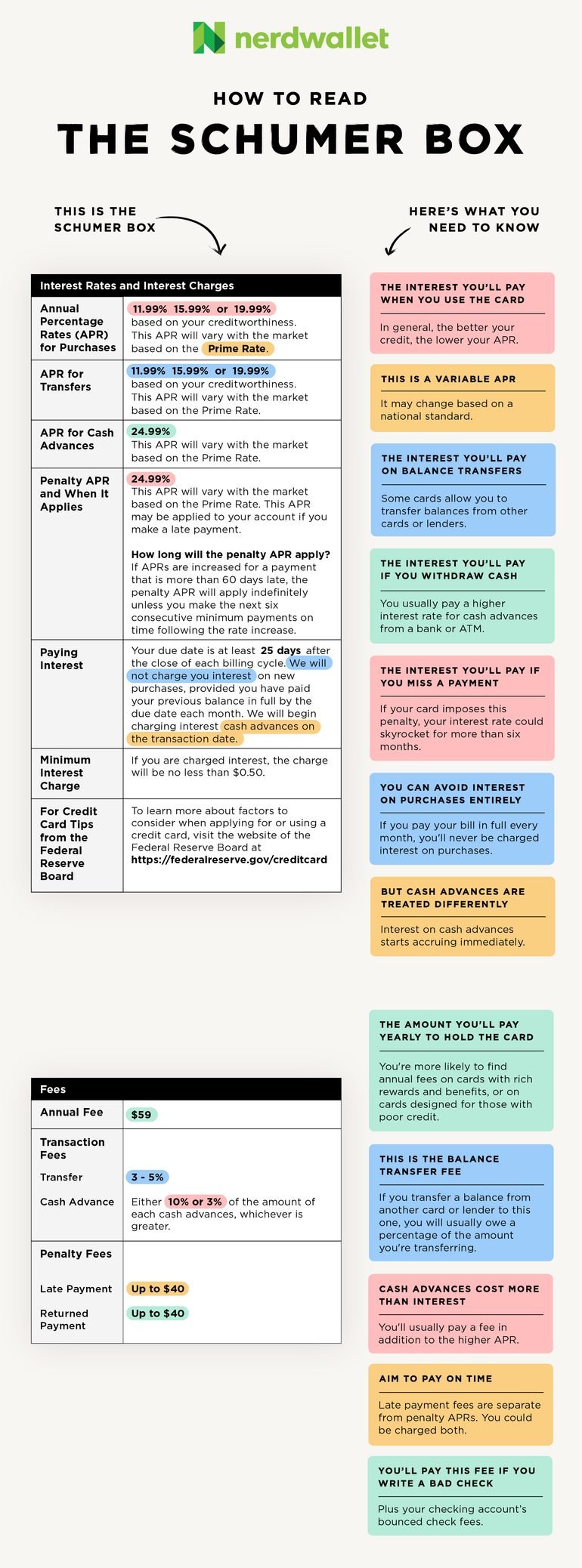
What does the Schumer box tell you?
Broadly, two main things: interest rates and fees.
1. The credit card's interest rates
These are expressed as APRs ("annual percentage rates"), and usually as variable ranges. This means they can change periodically in step with a benchmark figure called the prime rate — which is the lending rate that banks offer to customers with the best credit. If the prime rate rises, APRs on credit cards tend to do the same.
Those with excellent credit (FICO scores of 720 or higher) will qualify for the lowest APRs.
A card can have multiple APRs depending on the kind of transaction:
For purchases
For transfers
For cash advances
For paying late
This is the interest rate you'll be charged when you use the card to pay for things and you carry that balance from month to month. If, however, you pay your credit card bill on time and in full every month, this APR is irrelevant because you will never owe any interest.
If the credit card allows balance transfers from other lenders, this is the interest rate you'll be charged on those balances when you move them to the card.
This is the interest rate you'll be charged if you use the credit card to get a cash loan at a bank or ATM. In essence, you're "buying" cash instead of goods or services. While cash advances can be convenient for emergency use, they are also extremely expensive. That's because:
Penalty APRs for paying late are a bit less common these days, and even with credit cards that do charge them, they go into effect only under specific circumstances:
? Nerdy Tip
Some credit cards advertise deferred interest deals, aka "special financing." But this is not the same as a true 0% intro APR offer that you might see in a Schumer box. With deferred interest offers, you'll owe no interest if you pay off your entire purchase within the promo period. If, however, any balance remains when that window ends, you'll be charged interest retroactively for the full amount of the transaction, going back to the date of purchase. With 0% intro APR offers, interest is waived, not deferred. When the promo is over, you'll owe interest only on the remaining balance.
|
More about credit card APRs:
|
2. The credit card's fees
Credit cards can charge a variety of fees. Here are some of the most common:
Annual fee
Balance transfer fee
Cash advance fee
Foreign transaction fee
Late fees
This is the amount you'll pay each year to hold the credit card. Not all cards charge annual fees, but they can be worth paying, depending on the value that the card can deliver back to you.
This is the amount you'll pay for moving an existing balance onto the card. Not all cards allow balance transfers, and not all kinds of debts can be transferred. But the ones that do allow balance transfers tend to charge a fee for doing so, often 3% to 5% of the amount you're transferring.
That could add up to hundreds of dollars tacked onto your balance — but if the card offers a 0% intro APR on balance transfers, it may be worth the cost, depending on how much you're trying to pay off.
If you use your credit card to withdraw cash from a bank or ATM, you'll typically be charged a fee on top of the card's interest rate for cash advances.
This is the amount you'll pay for using the credit card internationally — often at least 3% of the purchase you're making.
Ready for a new credit card?
Create a NerdWallet account for insight on your credit score and personalized recommendations for the right card for you.

Create a NerdWallet account for insight on your credit score and personalized recommendations for the right card for you.
Where do you find the Schumer box?
If you're already a cardholder, the Schumer box will be a hard-to-miss table generally found on the first page of the card agreement that was mailed to you.
If you're researching or applying for a credit card, you may need to click around that card's website to find the Schumer box. It can vary from issuer to issuer, but here's where to start for cards from major issuers:
American Express
Bank of America
Barclays
Capital One
Chase
Citi
Discover
U.S. Bank
Wells Fargo
Why's it called the Schumer box?
The Schumer box is named for the lawmaker responsible for it. Chuck Schumer, a congressman and later senator from New York, pushed for legislation requiring that rates, fees and other terms on a credit card be prominently displayed to people when they apply for the card. The legislation passed in 1988, and the standardized disclosure came to be dubbed the Schumer box.
Helpful resources